
The 5 love languages?
Have you ever felt like you’re doing everything you can to show someone you care, yet they still don’t feel loved?
Or perhaps you’ve found yourself wishing your partner, friend, or family member would express affection differently.
If so, you’re not alone.
Many relationship misunderstandings happen not because people don’t love each other, but because they express and receive love in different ways. This idea is at the heart of the 5 Love Languages, a relationship framework developed by marriage counselor and author Gary Chapman.
The concept has helped millions of people better understand themselves, strengthen communication, and build deeper emotional connections.
In this guide, you’ll learn what the 5 love languages are, why they matter, examples of each one, their benefits and criticisms, and how to discover your own love language.
What Are the 5 Love Languages?
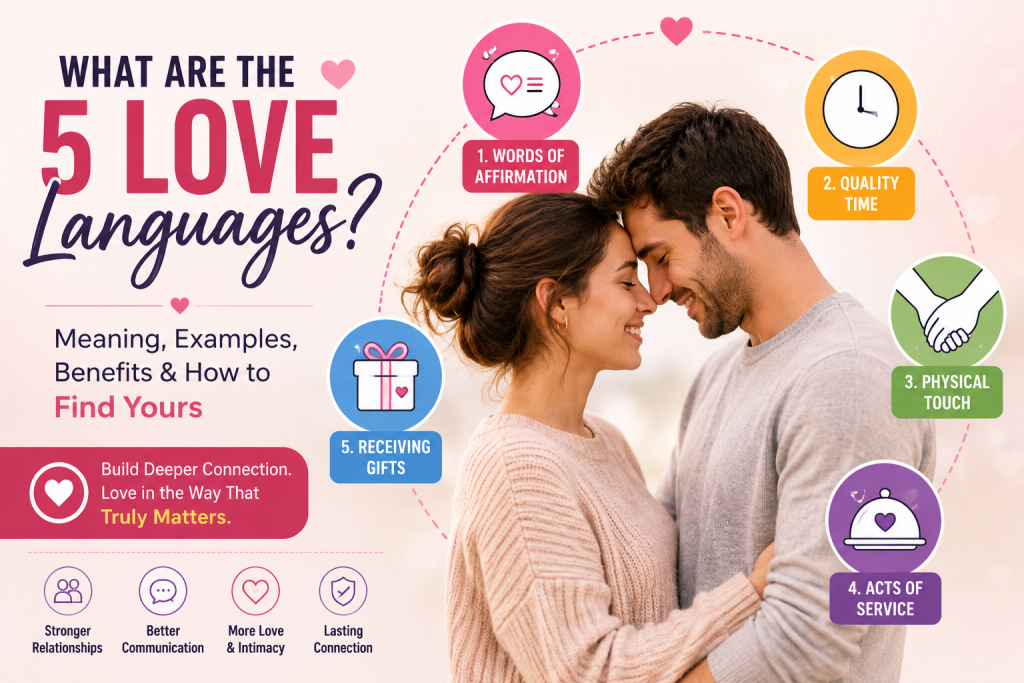
The 5 Love Languages are five different ways people tend to express and receive love:
Words of Affirmation
Quality Time
Physical Touch
Acts of Service
Receiving Gifts
According to Chapman, everyone appreciates all five to some degree, but most people have one or two primary love languages that make them feel especially valued and loved.
When partners understand each other’s love language, they can communicate affection in ways that resonate more deeply.
Why Love Languages Matter
Imagine a person who values Quality Time dating someone whose primary love language is Acts of Service.
The first partner wants uninterrupted conversations, shared experiences, and meaningful time together.
The second partner expresses love by fixing things around the house, helping with errands, and taking care of responsibilities.
Both people may genuinely care about one another, but if they don’t understand each other’s emotional needs, both may feel underappreciated.
Learning love languages helps bridge this gap.
It allows people to better understand:
How they naturally express affection
How they prefer to receive affection
Why misunderstandings happen in relationships
How to make loved ones feel genuinely appreciated
The History of the 5 Love Languages
The concept originated from relationship observations made by Gary Chapman while working with married couples.
Over time, he noticed a recurring pattern.
Many couples cared deeply for one another but struggled because they were expressing love in ways their partners didn’t naturally recognize.
These observations eventually led to the publication of his bestselling book, The 5 Love Languages, which introduced the framework to a global audience.
Today, the concept is widely discussed in relationship counseling, self-development circles, and popular psychology.
The 5 Love Languages Explained
1. Words of Affirmation
Words of Affirmation involve expressing love through spoken or written words.
People with this love language feel appreciated when they receive compliments, encouragement, gratitude, and verbal expressions of affection.
Examples include:
“I love you.”
“I’m proud of you.”
“You did an amazing job.”
Leaving thoughtful notes.
Sending encouraging text messages.
For these individuals, words have a powerful emotional impact.
Criticism, harsh language, or a lack of verbal appreciation can feel particularly painful.
Signs This Might Be Your Love Language
Compliments stay with you for a long time.
Encouraging words motivate you.
You frequently express appreciation verbally.
You enjoy receiving heartfelt messages.
2. Quality Time
Quality Time focuses on giving someone your full attention.
For people with this love language, being physically present isn’t enough. What matters is being emotionally present.
Examples include:
Going on a date without distractions.
Taking a walk together.
Having meaningful conversations.
Sharing hobbies and activities.
Listening attentively without checking your phone.
Quality Time is about connection, not simply proximity.
When someone consistently prioritizes distractions over spending time together, people with this love language may feel neglected.
Signs This Might Be Your Love Language
You value meaningful conversations.
You feel closest to people when spending time together.
You dislike being ignored during conversations.
Shared experiences mean more than material gifts.
3. Physical Touch
Physical Touch involves expressing love through appropriate physical affection.
This isn’t limited to romantic intimacy.
It can include:
Holding hands
Hugs
Cuddling
Sitting close together
A reassuring touch on the shoulder
For individuals with this love language, physical connection communicates warmth, security, comfort, and emotional closeness.
Signs This Might Be Your Love Language
Hugs instantly make you feel better.
Physical affection helps you feel connected.
You naturally show care through touch.
Lack of physical affection feels emotionally distant.
4. Acts of Service
Acts of Service involve doing helpful things that make life easier for someone else.
Actions truly speak louder than words for people with this love language.
Examples include:
Cooking dinner
Helping with chores
Running errands
Filling the car with gas
Completing a task your partner dislikes
The effort behind the action is what matters.
When someone willingly helps without being asked repeatedly, it communicates care and consideration.
Signs This Might Be Your Love Language
Helpful actions mean more than compliments.
You notice thoughtful gestures immediately.
Broken promises disappoint you deeply.
You often help others to show you care.
5. Receiving Gifts
Receiving Gifts is often misunderstood.
It isn’t about materialism.
Instead, the gift serves as a symbol of thoughtfulness, effort, and affection.
Examples include:
A handwritten card
A favorite snack
A meaningful souvenir
A birthday gift chosen carefully
A small surprise that shows someone was thinking about you
For people with this love language, the emotional meaning behind the gift matters far more than the price tag.
Signs This Might Be Your Love Language
You remember meaningful gifts for years.
Thoughtful surprises make you feel appreciated.
You enjoy giving meaningful gifts to others.
The symbolism behind a gift matters to you.
How to Identify Your Love Language
Many people can identify their love language by asking themselves a few simple questions.
What Makes You Feel Most Loved?
Do you feel most loved when someone:
Gives you compliments?
Spends uninterrupted time with you?
Hugs or holds your hand?
Helps you with responsibilities?
Surprises you with thoughtful gifts?
Your answer may reveal your primary love language.
What Do You Complain About Most?
Relationship complaints often reveal emotional needs.
Examples:
“You never spend time with me.” → Quality Time
“You never notice what I do.” → Words of Affirmation
“You never help me.” → Acts of Service
“You never touch me anymore.” → Physical Touch
“You never think about special occasions.” → Receiving Gifts
How Do You Naturally Show Love?
People often give love in the way they prefer to receive it.
Ask yourself:
Do I compliment others often?
Do I enjoy helping people?
Do I buy thoughtful gifts?
Do I prioritize spending time together?
Do I express affection physically?
Your answer may provide valuable clues.
How to Identify Your Partner’s Love Language
Understanding your partner’s love language can strengthen communication and emotional intimacy.
Pay attention to:
What they ask for most often
What they complain about
How they show affection
What makes them happiest
You can also discuss love languages openly and compare your preferences.
The goal isn’t to label one another but to understand each other’s emotional needs better.
Benefits of Understanding Love Languages
Improved Communication
Understanding love languages helps partners communicate affection more effectively.
Stronger Emotional Intimacy
People feel more connected when their emotional needs are recognized and respected.
Greater Empathy
Learning another person’s love language encourages you to see the relationship from their perspective.
Reduced Misunderstandings
Many relationship conflicts stem from unmet expectations.
Love languages provide a framework for understanding these differences.
More Intentional Relationships
When people understand how their loved ones experience affection, their actions become more meaningful.
Can Your Love Language Change?
Yes.
Love languages can evolve over time.
Life experiences, personal growth, stress, parenting, career changes, and relationship dynamics can all influence how people prefer to give and receive love.
Someone who once valued Physical Touch most may later find Quality Time more meaningful.
This is why regular communication remains important.You can take a quiz to get to know your love languages and that of your partner today.
Are There Other Love Languages?
While the original framework contains five love languages, some researchers and relationship experts have proposed additional concepts, including:
Emotional security
Shared experiences
Intellectual connection
Appreciation
Emotional support
However, the original five remain the most widely recognized and studied.
Criticisms of the Love Languages Theory
Although many people find the framework helpful, it isn’t without criticism.
It May Oversimplify Relationships
Human relationships are complex.
Reducing emotional needs to five categories may not fully capture individual experiences.
People Often Need Multiple Love Languages
Most individuals appreciate all five love languages to varying degrees.
It Doesn’t Solve Every Relationship Problem
Understanding love languages cannot replace:
Healthy communication
Trust
Respect
Emotional maturity
Conflict resolution
Research Findings Are Mixed
Some studies suggest that understanding love languages may improve relationship satisfaction.
Others argue that relationship success depends more heavily on communication skills, emotional intelligence, empathy, and mutual effort.
For this reason, love languages should be viewed as a helpful relationship tool rather than a universal solution.
Frequently Asked Questions
What is the most common love language?
Research findings vary, but Quality Time and Words of Affirmation frequently rank among the most commonly reported love languages.
What is the rarest love language?
Receiving Gifts is often reported less frequently than other love languages, though this can vary by population and study.
Can you have more than one love language?
Yes. Most people have a primary love language and one or more secondary love languages.
Can love languages improve relationships?
They can improve understanding, communication, empathy, and emotional connection when both partners actively apply them.
Is there a love language quiz?
Yes. Many people use love language assessments to identify their primary and secondary love languages.
Final Thoughts
The 5 Love Languages provide a simple but powerful framework for understanding how people give and receive love.
Whether your love language is Words of Affirmation, Quality Time, Physical Touch, Acts of Service, or Receiving Gifts, recognizing these preferences can help improve communication, deepen emotional intimacy, and strengthen relationships.
The most important lesson isn’t simply discovering your own love language.
It’s learning how the people you care about experience love and making a conscious effort to meet them there.
When love is expressed in a way that resonates with another person, relationships often become more connected, meaningful, and fulfilling.
One response to “What Are the 5 Love Languages? Meaning, Examples, Benefits & How to Find Yours”
I enjoy reading this. I was confused about my partner’s connection to me now I understand that his love language is different from mine. Thanks for this.